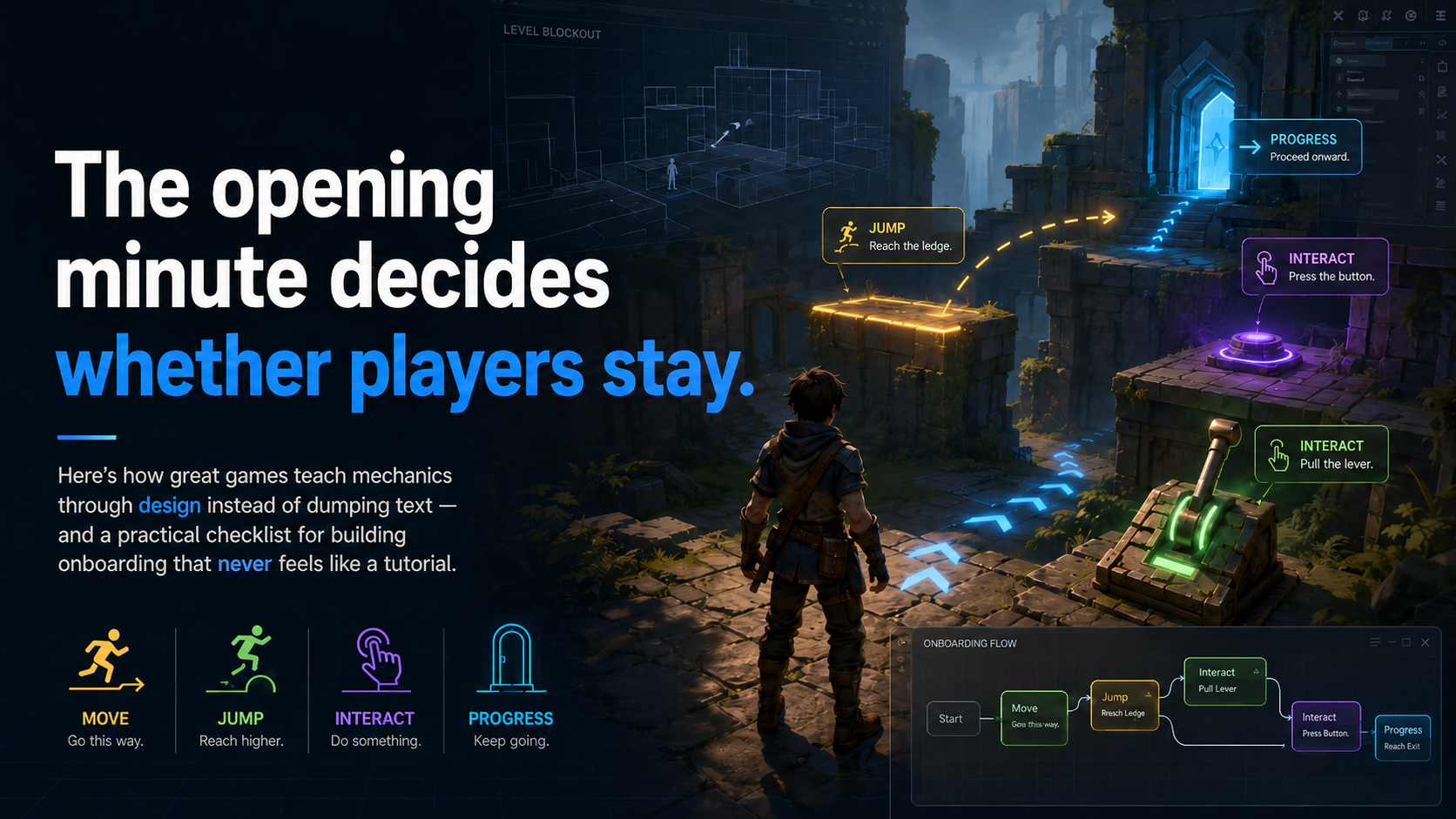
Players decide fast. Long before they've seen your story, your systems, or the clever thing you spent three months building, they've already formed an opinion — usually within the first minute. If those sixty seconds feel confusing, slow, or condescending, a meaningful chunk of your audience quietly closes the game and never comes back.
This is why onboarding is one of the highest-leverage things you can design, and also one of the most commonly botched. The default failure mode is the tutorial wall: a screen full of text and button prompts that asks players to read and memorize before they're allowed to play. It's the digital equivalent of handing someone an instruction manual at a party. The good news is that the best games solved this decades ago, and the underlying principles haven't changed.
Teach through the world, not through text
The most-cited example in all of game design is still the opening screen of Super Mario Bros. World 1-1. There's no text. Within seconds, the level has taught you that left is where you came from and right is where you're going, that the mushroom-shaped enemy is dangerous, that jumping is your verb, and that the glowing block rewards curiosity. Every one of those lessons is delivered through layout, placement, and consequence — not instruction.
The principle: let the environment ask the question, and let the player's action answer it. A gap teaches jumping. An enemy approaching teaches threat. A shiny object teaches reward. When a mechanic is introduced by the space itself, the player doesn't learn a rule — they discover a truth, and discovered truths stick.
Introduce one thing at a time
A reliable way to overwhelm a new player is to hand them six mechanics in the first room. Strong onboarding isolates. Portal is the textbook case: you get the portal gun, but for the first several chambers the game heavily restricts what you can do with it, layering in one new idea per room — blue portal, then orange, then momentum, then combining them. By the time the puzzles get genuinely hard, you've internalized the toolkit without ever being lectured on it.
Map your mechanics to a sequence. Each new idea gets its own moment to be understood in isolation before it's combined with anything else. If two concepts are competing for the player's attention in the same beat, split them apart.
Make early failure safe
Players experiment far more freely when the cost of being wrong is low. Many well-designed openings are quietly forgiving — generous checkpoints, no permadeath in the first zone, enemies that telegraph slowly. Celeste introduces its dash in a controlled space where falling just resets you a few feet back, so you're free to fumble the timing until it clicks. Safe failure turns the opening into a sandbox instead of an exam.
The corollary: don't punish curiosity. If a player wanders off the intended path in the first minute and gets instantly killed for it, you've taught them that exploration is dangerous — usually the opposite of what you want.
The introduce → develop → twist pattern
A useful structure for teaching any single mechanic across a stretch of early play:
- Introduce it in a safe, obvious context where its function is unmistakable.
- Develop it by asking the player to use it under slightly more demanding conditions.
- Twist it by combining it with something else or subverting the expectation you just built.
This rhythm shows up everywhere from Mega Man boss-weapon design to Nintendo's level construction. It respects the player's intelligence — you're not repeating the lesson, you're escalating it — while still guaranteeing the mechanic is understood before it becomes load-bearing.
Let players move while they learn
Few things kill momentum faster than freezing the player to display a tooltip. Half-Life famously refused to take the camera away from you; you learn the world while walking through it, with the environment and scripted events doing the teaching as you move. Whenever possible, deliver instruction during play, not in a modal that pauses it. If you must show a prompt, keep it short, contextual, and dismissible — and never block input behind it.
Respect the experienced player
Onboarding isn't only for newcomers. Some of your players have played a hundred games in your genre and will resent being walked through basics. Build in graceful escape hatches: let prompts be skipped, let the tutorial be optional, and let a confident player blow through the opening at their own pace. A good rule of thumb is that onboarding should be invisible to people who don't need it and supportive to people who do.
A practical checklist
Before you ship your opening, run it against these questions:
- Can a brand-new player understand the core verb without reading anything?
- Is each new mechanic introduced one at a time, with room to breathe?
- Is failure in the first zone cheap and recoverable?
- Does the environment do the teaching, or are you relying on text?
- Can an experienced player skip ahead without friction?
- Have you watched a real person — not yourself — play the first sixty seconds silently, without you explaining anything?
That last one is the real test. You know your game too well to judge its opening; you've lost the ability to be confused by it. Put it in front of someone who has never seen it, say nothing, and watch where their attention goes and where they hesitate. Every place they get stuck is a place your design failed to communicate — and the first minute is exactly where you can least afford that.
Get the opening right and you've bought yourself the most valuable thing in game design: a player who wants to keep going.