GameDesignerX Blog

Product updates, design notes, and what we are working on in GameDesignerX.

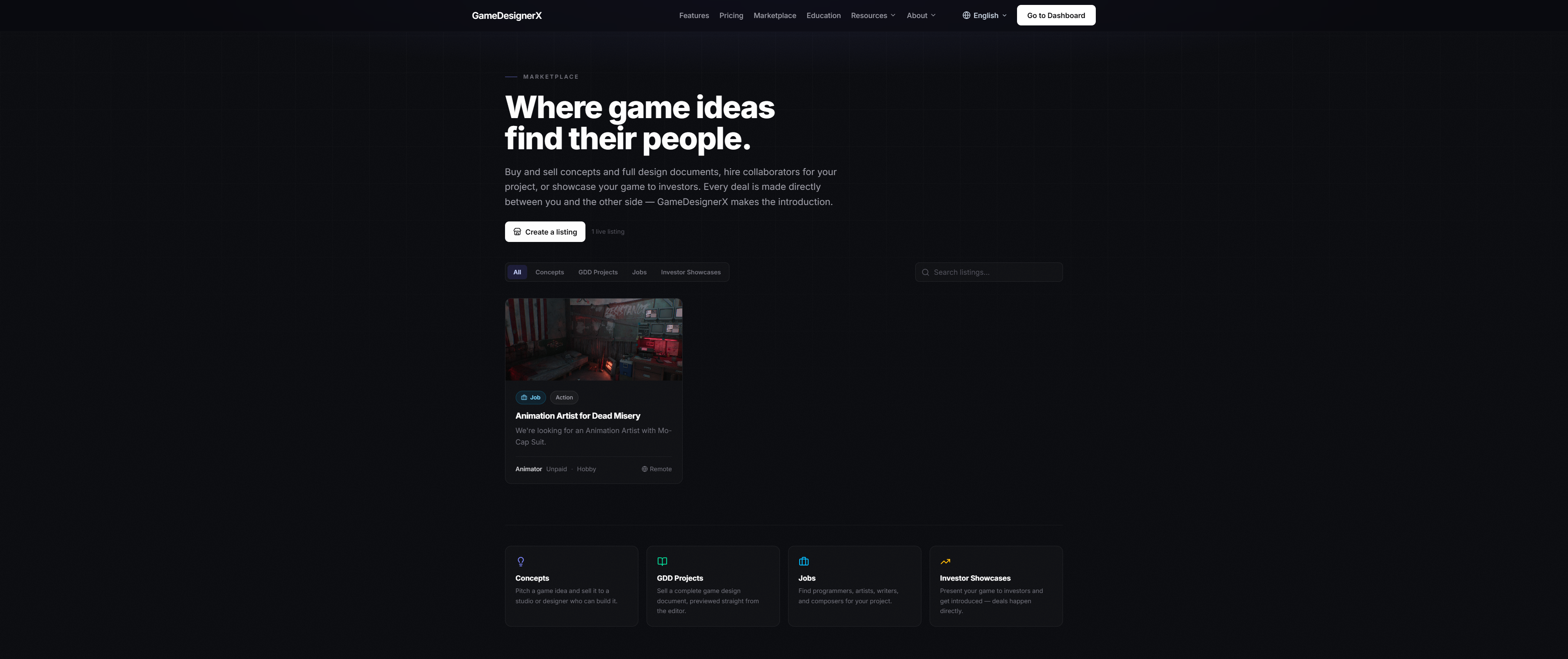
Introducing the GameDesignerX Marketplace: Sell Concepts, Find Collaborators, Meet Investors
Featuredannouncement

Introducing the GameDesignerX Marketplace: Sell Concepts, Find Collaborators, Meet Investors

The GameDesignerX Marketplace is live. Buy and sell game concepts and full design documents, hire collaborators for your project, or put your game in front of investors — with every deal made directly between you and the other side.

Marc FrädrichJuly 18, 20264 min read
Read post
GDX
level artmodular kits

Build the Kit, Not the Room: Planning Modular Level Art That Snaps Together

Bespoke rooms don't scale. A practical plan for a modular level kit: picking a grid and module size, pivot and snap rules, a 24-piece starting set, trim sheets, and greybox counterparts so blockouts convert to final art without a rebuild.

GameDesignerX Team7 min
GDX
netcodemultiplayer

Your Netcode Is a Design Constraint: Picking Mechanics That Survive Online Play

Latency is not a bug your programmers will fix later. Budget the delay, pick an authority model, and specify timing windows and arbitration before you build the ability.

GameDesignerX Team7 min
GDX
systems designemergent gameplay

Fire, Water, Wood: Designing an Interaction Matrix That Multiplies Your Mechanics

Emergent gameplay comes from a grid, not a grand simulation. Here is how to build a verbs-by-materials interaction matrix, budget its combinatorics, and sort the exploits it produces into keep, price and kill.

GameDesignerX Team7 min
GDX
performancelevel design

Thirteen Milliseconds: Writing a Performance Budget Your Designers Can Build Against

Performance is a design constraint, not a bug list. How to split a frame budget into named slices, turn it into caps designers can place by hand, and check it weekly on your weakest device.

GameDesignerX Team7 min
GDX
consoleporting

Cert Is a Milestone, Not a Formality: Preparing Your Console Submission

Certification is a pass/fail gate, not paperwork. Here is what platform holders actually check — lifecycle, glyphs, save integrity, metadata — plus a 16-week timeline and a 30-minute compliance test pass you can run on hardware before you submit.

GameDesignerX Team7 min
GDX
new game plusreplayability

Earning the Second Run: Designing New Game Plus Without Just Doubling Enemy HP

A flat health multiplier makes the second run longer, not better. Here is how to spec New Game Plus: a carry-over matrix, a scaling table that caps health and raises damage, exclusive content, and a way to playtest it.

GameDesignerX Team7 min
GDX
moddingdata-driven

Mod Support Without Giving Away Your Source: A Data-First Plan for Small Teams

Players will modify your game whether you plan for it or not. Here is the exposure ladder, the patch format, the versioning policy and the pre-release checklist that make mod support cheap instead of a year-two refactor.

GameDesignerX Team7 min
GDX
pricingmarketing

What to Charge: A Pricing Method for Your First Commercial Game

Pricing is a design decision, not a last-minute guess. Build a net-per-unit model, three price anchors and a two-year discount calendar before your store page goes live.

GameDesignerX Team7 min
GDX
animationgame feel

Startup, Active, Recovery: An Animation Spec Your Team Can Build Against

Count your animation states before you commission art, give every move a startup/active/recovery contract, and decide up front what gets hand-animated and what gets faked.

GameDesignerX Team7 min
GDX
skill treesprogression

Skill Trees That Make Builds, Not Shopping Lists

Five playtesters, five nearly identical builds. Build variety is a structural property of your skill tree, not a tuning problem: how to pick a topology, cost nodes against a point budget, and run a one-afternoon diagnostic that proves the tree has more than one answer.

GameDesignerX Team8 min
GDX
releaseproduction

Content Lock: A Four-Week Runbook for the Weeks Before You Ship

The last month before launch is where releases get decided. Three separate freezes, a bug bar written before you need it, and a release-candidate checklist you can actually sign off.

GameDesignerX Team7 min
GDX
companionsai

Companions That Help: Designing an AI Ally Players Don't Resent

Most companion characters fail for design reasons, not AI reasons. Leash distances, contribution budgets, stealth rules and a bark cooldown that keep an ally useful instead of annoying - plus an eight-point playtest checklist.

GameDesignerX Team7 min
GDX
outsourcingart briefs

Briefing a Freelance Artist: The Asset Spec That Prevents Three Rounds of Revisions

Commissioned art that needs repainting is a brief problem, not an artist problem. A six-block asset brief - context, technical spec, reference, deliverables, revision policy and acceptance criteria - plus the test-asset milestone that saves a batch.

GameDesignerX Team7 min
GDX
debug toolstooling

Build the Cheat Menu First: Debug Tooling That Pays for Itself in a Week

Testing an hour-four boss shouldn't cost eleven minutes of walking per attempt. A tiered plan for the debug commands, overlays and state snapshots small teams should build before the content they tune.

GameDesignerX Team7 min
GDX
game jamsscope

Finish the Jam: Scoping a 48-Hour Game So You Actually Submit

Most jam games fail on scope, not speed. An hour-by-hour plan for a 48-hour jam: the one-mechanic rule, countable content budgets, a cut list you write on day one, and a pre-submission checklist.

GameDesignerX Team7 min
GDX
barksdialogue

Barks That Don't Wear Out: Budgets, Cooldowns and Priority for Reactive Dialogue

Barks are the most-heard writing in your game and usually the last written. A practical system for trigger tables, priority tiers, per-line lockouts and shuffle bags, with the line-count maths before you book a recording booth.

GameDesignerX Team7 min
GDX
factionsreputation

Friend of Nobody: Designing Faction Reputation Players Can Actually Track

Faction reputation fails when players cannot tell why a merchant suddenly hates them. Pick a shape, design five named tiers, derive your deltas from a pace, and make every consequence legible — with a cost table and a playtest checklist you can use today.

GameDesignerX Team7 min
GDX
naming conventionspipeline

Name It Once: A Naming Convention That Keeps Your Design Docs and Your Build in Sync

Four names for one sword is twenty minutes of grep per bug. A practical ID and asset naming convention for small teams: stable IDs vs display names, a grammar you can type from memory, and a rename procedure that does not break old saves.

GameDesignerX Team7 min
GDX
post-mortemretrospective

Ship, Then Learn: A Post-Mortem Format That Changes the Next Project

Most post-mortems produce twenty improvements and change nothing. Here is an evidence-first format: a reconstructed timeline, a two-session agenda, and a hard cap of five changes with owners and triggers.

GameDesignerX Team7 min
GDX
trailersmarketing

Cut the Trailer Before You Film It: A Shot List for Your Game's First 75 Seconds

Most indie trailers waste their first eighteen seconds on a logo and a slow camera pan. Here is a beat sheet, shot list and capture workflow for a 75-second trailer that still reads clearly with the sound off.

GameDesignerX Team7 min
GDX
status effectssystems design

Burning, Chilled, Stunned: Designing Status Effects That Stack Without Breaking Your Game

Status effects are the cheapest content in your game and the fastest way to lose control of your combat math. Here is a six-field spec, four stacking models, diminishing returns for crowd control, and an afternoon balance pass that finds the broken stack before your players do.

GameDesignerX Team7 min
GDX
content budgetproduction

How Long Is Your Game? Content Budgeting From a Playtime Target

Playtime is a budget, not a marketing adjective. Measure minutes per content unit and build days per unit, then do the division before you promise hours on a store page.

GameDesignerX Team7 min
GDX
level designmap design

Locks, Keys and Shortcuts: Designing an Ability-Gated Map That Never Softlocks

Ability-gated maps fail as graphs, not as rooms. Build the gate graph before the geometry, run a five-step reachability pass, and audit every one-way drop with a softlock checklist.

GameDesignerX Team7 min
GDX
itemssystems design

Inventory Limits Are a Design Choice: Slots, Weight, Grids and the Friction You Want

Carry capacity is a tax you charge players for bringing power into a room. How to choose between slots, weight, grids and category caps, derive the numbers from a target session length, design what happens when the bag is full, and playtest the result.

GameDesignerX Team8 min
GDX
time systemsmechanics

Clocks, Calendars and Countdowns: Designing Time as a Mechanic

A day/night shader is decoration; a clock is a pressure system. Four time architectures, how to derive your in-game-to-real-time rate, the three numbers to document, and a playtest checklist for timed games.

GameDesignerX Team7 min
GDX
ux writingui

Microcopy Is Design: The UI Text Players Actually Read

Denial messages, item cards and button labels decide whether players can see your systems at all. A practical workflow for word budgets, a voice sheet, string keys and a one-hour review pass before every playtest.

GameDesignerX Team7 min
GDX
conventionsdemo

The Show Floor Build: A Festival Demo That Survives Ten Hours of Strangers

A convention build is not your Steam demo with a shorter level. How to cut it to six minutes, add an attract loop, make it reset in five seconds, and collect real data in a room far too loud for surveys.

GameDesignerX Team8 min
GDX
balancingcombat

Damage Formulas That Keep Every Stat Worth Taking

Why most balance problems are formula problems, not number problems. Pick a mitigation shape, price every stat in % DPS or % effective HP, and validate three reference builds before anyone plays it.

GameDesignerX Team7 min
GDX
design pillarspreproduction

Design Pillars That Cut Features: Writing Constraints Your Team Will Actually Use

Most design pillars are compliments nobody can argue with. Here is how to write three to five sentences that actually forbid features, how to run the 90-minute workshop that produces them, and how to keep a ledger that proves they are load-bearing.

GameDesignerX Team7 min
GDX
failure designgame feel

The Three Seconds After Death: Designing Failure, Retry and Recovery

Failure is a mechanic with its own budget. How to set retry times, split the cost of death across time, progress, resources and knowledge, and make sure players can always name what killed them.

GameDesignerX Team7 min
GDX
level designwayfinding

Signposting Without Waypoints: Guiding Players With Landmarks, Light and Sightlines

Players rarely get lost because a level is big — they get lost because nothing in the 30-80 m range says which way is forward. A three-tier signposting method, a landmark registry and a lost-player playtest you can run on greybox.

GameDesignerX Team7 min
GDX
data-drivenworkflow

Tune It in a Table: Designing a Content Schema Your Team Can Edit Without a Programmer

Your game's balance will only be as good as your iteration count. Here's how to design the data schema and pipeline that turns a two-day tuning round trip into a four-second one.

GameDesignerX Team7 min
GDX
prototypingpreproduction

Paper Before Pixels: Prototyping Game Systems in an Afternoon

Index cards, graph paper and a d20 will answer most of your balance questions faster than your engine will. Four paper-prototype rigs, a session format that produces real data, and the numbers worth keeping afterwards.

GameDesignerX Team8 min
GDX
roguelikerun structure

Runs, Not Levels: Designing the 25-Minute Roguelike Loop

A run is a unit of design with its own length, pressure curve and climax. How to pick a run length, budget stages against it, split power between items, meta-progression and skill, and validate it all with a run ledger.

GameDesignerX Team7 min
GDX
pitchingpublishers

The Twelve-Slide Publisher Pitch: What Goes on Each Slide and Why

A slide-by-slide build order for an indie publisher pitch deck, plus the three attachments, the due-diligence checklist and the rehearsal that stops you fumbling the hard questions.

GameDesignerX Team7 min
GDX
co-opmultiplayer

Co-op Isn't Single-Player Times Two: Designing for Two to Four Players

Adding a second player breaks loot, puzzles, bosses and your camera at once. A practical spec for co-op: resource ownership models, sub-linear scaling ratios, revive numbers and a playtest checklist.

GameDesignerX Team7 min
GDX
early accessproduction

Early Access Without the Death Spiral: Roadmaps, Patch Cadence and Exit Criteria

Early Access is a schedule you have to keep in public for a year. Here is how small teams set the 1.0 line, pick a patch cadence they can hit on a bad week, and turn forum noise into a prioritised queue.

GameDesignerX Team7 min
GDX
enemy aistealth

Suspicious, Alert, Hunting: Designing Enemy AI States Players Can Read

Enemies that feel unfair are usually a perception problem, not an intelligence one. A practical model for sight cones, hearing radii, awareness meters and four readable AI states — with the numbers and the state table to tune them.

GameDesignerX Team7 min
GDX
steammarketing

Your Store Page Is a Deliverable: A Steam Page Build Order for Small Teams

A Steam store page has dependencies and a build order, just like a vertical slice. Here is the order to build it in, from the one-line promise to the trailer, with capsule sizes, screenshot jobs and a pre-announce checklist.

GameDesignerX Team7 min
GDX
procedural generationlevel design

Procedural With Intent: What to Generate and What to Hand-Build

Most small-team procedural generation fails because the machine is asked to invent the wrong half of the level. A practical split between authored rooms and generated arrangement, with testable constraints, seed workflows and a pre-build checklist.

GameDesignerX Team7 min
GDX
narrativelocations

Tell It With the Room: Environmental Storytelling That Needs No Audio Logs

Four well-chosen props can carry a plot point that would otherwise need a cutscene. A three-cue method for building rooms players can read, a prop vocabulary your team can share, and the one playtest question that proves whether the story landed.

GameDesignerX Team8 min
GDX
craftingitems

Crafting Without Busywork: Designing Recipe Trees Players Can Reason About

A practical method for crafting systems: build a small ingredient vocabulary, pick the right chain depth, price recipes in player-minutes, and test with the empty-inventory walk.

GameDesignerX Team8 min
GDX
build trackingproduction

Which Build Was That? Version Numbers and Build Notes That Save Your Playtest Data

A bug report without a build ID is an anecdote. A practical versioning scheme, a five-field build manifest and a pre-handoff checklist that keep small-team playtest data usable.

GameDesignerX Team7 min
GDX
preproductionidea log

Kill Nine Ideas to Ship One: A Concept Selection Process for Small Teams

Choosing which game to build is the most expensive decision a small team makes. Here is a two-week process: six-field idea cards, a weighted scoring table, one-week spikes with kill criteria written in advance, and rejections logged for later.

GameDesignerX Team7 min
GDX
game feelcombat

Hit Feedback in Frames: Designing Impact With Hit-Stop, Shake and Knockback

Impact is not polish, it is six numbers per attack. A frame-by-frame guide to hit-stop, screen shake, hit flash and knockback, with starting values, a feedback spec table and a thirty-minute tuning pass.

GameDesignerX Team7 min
GDX
productionsprints

Sprints for Three People: A Task Board That Survives Real Game Production

A stripped-down sprint loop for teams of two to five: how to budget real capacity, write a sprint goal a playtester can confirm, and kill the carry-over cards that make boards rot.

GameDesignerX Team7 min
GDX
accessibilityux

Accessibility on an Indie Budget: A Feature Ladder You Can Ship in Stages

Most accessibility work is cheap if you do it early and brutally expensive to retrofit. Here is a three-tier ladder for small teams: the rungs to build into your input and UI systems now, the ones to schedule as sprint work, and seven tests you can run in ninety minutes.

GameDesignerX Team7 min
GDX
demosteam

Demo Design: Picking the 20 Minutes That Decide Whether Players Come Back

Most first demos ship the tutorial instead of the game. A workflow for scoring three candidate slices, budgeting the minutes, cutting hard, and instrumenting the largest playtest you will never attend.

GameDesignerX Team7 min
GDX
narrativestory chapters

Beat Sheet to Chapters: Structuring a Game Story Your Team Can Actually Build

Turn a prose story outline into chapter cards that declare their cost, their gate and their dependencies. A five-step workflow, a worked example and a checklist for small teams.

GameDesignerX Team7 min
GDX
boss designencounter design

Boss Fights That Teach: Phases, Tells and the Numbers Behind the Encounter

A boss should be an exam for skills your game already taught, not a wall with a health bar. A structure for phases, tells and arenas, a way to derive boss HP from a target fight length, plus a fairness checklist and the playtest questions that reveal an unreadable fight.

GameDesignerX Team8 min
GDX
metricslevel design

Metrics First: Lock Your Character's Numbers Before You Build a Single Level

Jump height and apex time decide every gap, ledge and ceiling in your game. Here is how to derive a level-dimension kit from eight movement numbers, prove it with a calibration room, and stop silent tuning changes from breaking finished levels.

GameDesignerX Team7 min
GDX
uihud

What Belongs on the HUD: An Information Audit for Your Game's UI

Most HUDs show twenty things and communicate four. Run a three-question audit on every on-screen element, then push what survives into the world, the audio or an on-demand screen.

GameDesignerX Team7 min
GDX
milestonesproduction

The Vertical Slice: Defining a Milestone Your Team Can Actually Finish

A vertical slice proves your game works, but only if you define it before you build it. Here is how to scope one in minutes instead of features, write binary exit criteria, and sequence six weeks of work backwards from the review.

GameDesignerX Team7 min
GDX
puzzle designlevel design

Teach, Test, Twist: A Puzzle Design Loop That Players Can Actually Read

Most unfair puzzles aren't too hard — they ask a question the player was never taught to read. A three-beat structure, a verb-noun vocabulary grid and a pre-build checklist for designing rooms players solve without a walkthrough.

GameDesignerX Team7 min
GDX
telemetryplaytesting

Ten Events Worth Logging: Instrument Your Prototype Before the Next Playtest

"It was fun" tells you nothing. A handful of logged events turns a playtest into a funnel table and a death heatmap you can act on. What to log, how to store it, and what numbers will never tell you.

GameDesignerX Team7 min
GDX
audiogame feel

Audio Is Design, Not Polish: A Sound Spec Your Small Team Can Actually Ship

Your jump feels weightless because the landing only makes one noise. A practical sound spec for small teams: audible-moment lists, variation counts, voice limits, layered impacts, a headroom budget and a file naming convention.

GameDesignerX Team7 min
GDX
lore bibleworldbuilding

The Ten-Page Lore Bible: Canon Tiers, Naming Systems and a Contradiction Pass

A lore bible exists to answer production questions in under a minute, not to impress anyone. Here is a ten-page skeleton, a three-tier canon system, naming rules that scale, and a 30-minute contradiction pass that catches real bugs.

GameDesignerX Team7 min
GDX
progressionbalancing

Power Curves and Unlock Gates: How to Pace Progression Without Grind

Progression is a schedule, not a multiplier. Split your rewards into power, access and identity, budget one new toy per session, and check your XP curve against a clock before you build thirty levels.

GameDesignerX Team7 min
GDX
bug triageqa

Triage or Drown: A Bug Workflow for Teams Without a QA Department

An untriaged bug list stops being a list and becomes a landfill. Here is a twenty-minute-twice-a-week triage process: intake rules, severity vs priority, a build-linked lifecycle, and the two numbers that predict your launch date.

GameDesignerX Team8 min
GDX
cameragame feel

Your Camera Is a Mechanic: Deadzones, Lookahead and Framing Rules

Players never report camera bugs — they report floaty jumps and unfair bosses. Here are the four camera parameters worth documenting, plus a one-hour tuning pass that fixes feedback you thought was a movement problem.

GameDesignerX Team7 min
GDX
difficultybalancing

Hard Mode Isn't a Multiplier: Designing Difficulty as Four Separate Knobs

Most difficulty modes just double the numbers and make failure more expensive. Split difficulty into execution, resources, punishment and information, put the values in a table, and test them with attempt counts.

GameDesignerX Team7 min
GDX
core loopgame design

The Three Loops: Designing Your Game at 30 Seconds, 30 Minutes and 30 Hours

Most indie games nail the moment-to-moment feel and then lose players at minute 25. Map your moment, session and progression loops with real numbers, wire their exits together, and diagnose playtest feedback by which loop it implicates.

GameDesignerX Team7 min
GDX
questsobjectives

Quests That Aren't Errands: A Structure Kit for Objective Design

Most weak quests aren't badly written, they're structurally empty. A five-beat spine, a quest-type budget, knowledge gates and a review checklist for designing objectives that change the player's state.

GameDesignerX Team7 min
GDX
art directionmood boards

Mood Boards That Direct Art Instead of Decorating a Folder

Most art references collect images without stating a single rule, so contractors guess and deliver work you reject. Here is how to build a mood board with pillars, captions, specs and tests that can actually fail an asset.

GameDesignerX Team7 min
GDX
risk logproduction

The Pre-Mortem: A Risk Log That Actually Changes What You Build

Assume your project already failed, then work backwards. A 45-minute pre-mortem plus a risk log with owners, scores and tripwires turns vague worries into decisions you make calmly instead of under deadline pressure.

GameDesignerX Team8 min
GDX
charactersnarrative

The Cast Grid: Design Characters From Relationships, Not Backstories

Character bios never tell you what happens when two people are alone in a room. Build the relationship grid first - want, obstacle and a concrete ledger for every live pair - and derive the cast from the pressures your story actually needs.

GameDesignerX Team7 min
GDX
save systemsmechanics

Checkpoints, Autosaves and Lost Progress: Designing a Save System Players Trust

Save design is a design problem, not plumbing. Set a worst-case lost-progress budget, pick a save model that hits it, sort state into three buckets, and version your files before you need to.

GameDesignerX Team8 min
GDX
lootbalancing

Drop Rates That Feel Fair: Weighted Loot Tables and Bad-Luck Protection

A 20% drop rate leaves 1 in 9 players empty-handed after ten kills. Here is how to design the tail instead of the average: single weighted tables, pity counters, escalating chances and a simulation you can run before you ship.

GameDesignerX Team7 min
GDX
pacinglevel design

The Intensity Curve: Pacing a Level With a Chart Instead of a Hunch

Score every beat in your level from 1 to 5 and read the sequence as a line. A practical pacing method for small teams, with worked examples, three rhythms that work, and a checklist to verify the curve against real playtesters.

GameDesignerX Team8 min
GDX
market analysisresearch

Competitor Teardowns That Change Your Design, Not Just Your Pitch Deck

Most competitor research ends up as a logo grid nobody opens again. Here is a two-day teardown method for indie teams that turns five games into scored axes, one defensible gap, and testable design constraints.

GameDesignerX Team7 min
GDX
enemy designcombat

One Verb Per Enemy: Building a Roster That Teaches Your Combat System

Most enemy rosters are reskins with two ideas between them. Design each enemy around a verb, give it a readable tell, and anchor its stats to time-to-kill — plus an encounter beat map and a playtest checklist.

GameDesignerX Team7 min
GDX
controlsux

Control Schemes That Don't Fight the Player: Bindings, Buffers and Tolerances

Players report that controls feel 'floaty' but never say why. Write down your action list, binding table and input tolerances — buffer, coyote time, deadzones — so you can tune real numbers instead of guessing at vibes.

GameDesignerX Team6 min
GDX
localizationworkflow

Localization Debt: Keeping Your Game Translatable While You Still Have Time

Concatenated sentences, baked-in text and fixed-width buttons quietly make your game untranslatable. Here are the habits, the expansion budget and the pseudo-localization test that keep shipping in eight languages a business decision, not a rewrite.

GameDesignerX Team7 min
GDX
achievementsgame design

Achievements Worth Chasing: A Design Framework for Small Teams

Achievement lists are one of the cheapest design surfaces in your game and one of the most wasted. Here is a framework for shaping a 24-achievement list by target unlock rate, with five achievement types, the anti-patterns to avoid, and a pre-ship checklist.

GameDesignerX Team8 min
GDX
documentationworkflow

Write It Down Once: A Design Decision Log That Stops Your Team Re-Arguing the Same Call

A five-field decision log records why your game is the way it is, not just what it is. Templates, a logging threshold, supersede rules, and habits that make it stick on small teams.

GameDesignerX Team7 min
GDX
level designblockout

Greybox First: A Level Blockout Workflow That Saves Months of Rework

A practical greyboxing workflow for indie teams: derive a metrics block from your movement numbers, snap everything to a grid, build from a beat sheet, and gate art behind a playtested blockout.

GameDesignerX Team7 min
GDX
dialoguenarrative

Branching Dialogue That Doesn't Explode: Node Budgets and Structures for Small Teams

Pure branching grows as 2^n, and no small team ships 256 tails of one conversation. Five structures, a node budget table and a pre-lock checklist for writing dialogue trees that feel reactive without multiplying the content you owe.

GameDesignerX Team7 min
GDX
productionscope

Cutting Scope Without Gutting Your Game: A Triage Method for Indie Production

A repeatable three-axis triage pass for deciding what stays, what shrinks and what dies before your milestone slips. Score features on pillar support, remaining cost and blast radius, then reduce before you cut.

GameDesignerX Team7 min
GDX
economybalancing

Faucets and Sinks: A Practical Method for Balancing Your Game Economy

Every currency your players earn has to go somewhere. A step-by-step method for listing faucets and sinks, converting them to gold-per-hour, and catching inflation before your testers hit four million gold.

GameDesignerX Team7 min
GDX
playtestinggame design

Running a Playtest That Actually Tells You Something

A practical framework for structuring playtest sessions around one falsifiable question, matching method to goal, and turning raw observations into ranked, actionable fixes.

GameDesignerX Team6 min
Game Design Portfolio: What Hiring Managers Actually Want

Game Design Portfolio: What Hiring Managers Actually Want

Discover what hiring managers want in a game design portfolio. Learn to showcase your skills effectively and boost your chances of landing a job.

15 min
Game Design Document: Template, Examples, and GDD Guide

Game Design Document: Template, Examples, and GDD Guide

Unlock effective game development with our ultimate game design document guide. Discover templates, examples, and best practices to streamline your process.

15 min
AI Game Design Tools for Collaborative GDDs in 2026

AI Game Design Tools for Collaborative GDDs in 2026

Explore Gamedesignerx for AI game design. Collaborate in real-time, streamline your GDD, and enhance your game development process today!

14 min
AI Worldbuilding for Game Designers: Studio Pipeline Guide

AI Worldbuilding for Game Designers: Studio Pipeline Guide

Discover a repeatable AI worldbuilding pipeline for game design. Streamline your process from concept to engine-ready assets today!

13 min
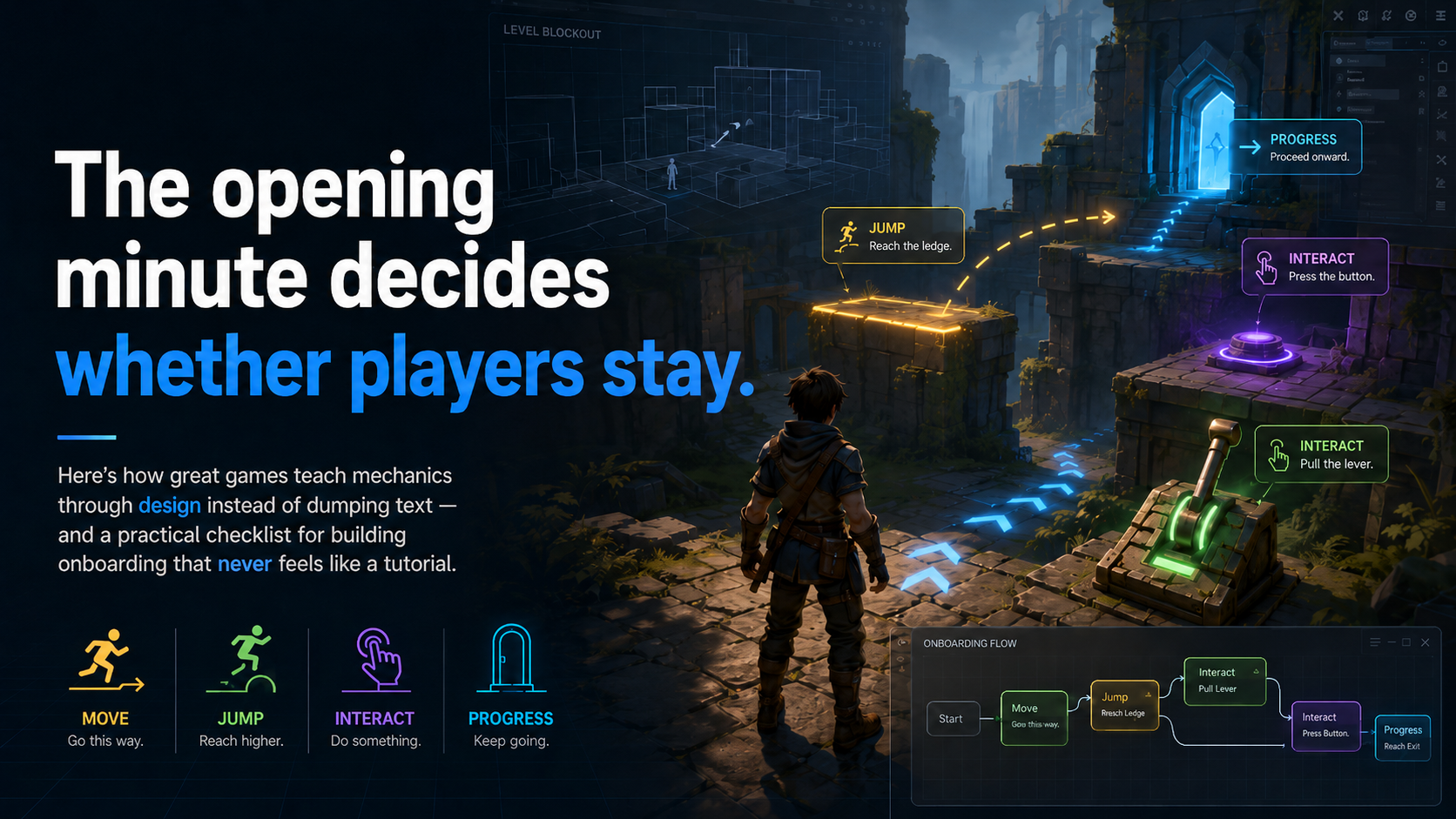
The First 60 Seconds: How to Onboard Players Without a Tutorial Wall
game designonboarding

The First 60 Seconds: How to Onboard Players Without a Tutorial Wall

The opening minute decides whether players stay. Here's how great games teach their mechanics through design instead of dumping text — and a practical checklist for building onboarding that never feels like a tutorial.

Marc Frädrich5 min
Core Game Design Principles: The Fundamentals Every Designer Should Know
game designgame development

Core Game Design Principles: The Fundamentals Every Designer Should Know

Nine essential principles that separate games players love from ones they forget — a primer on the craft of designing experiences.

Marc Frädrich6 min
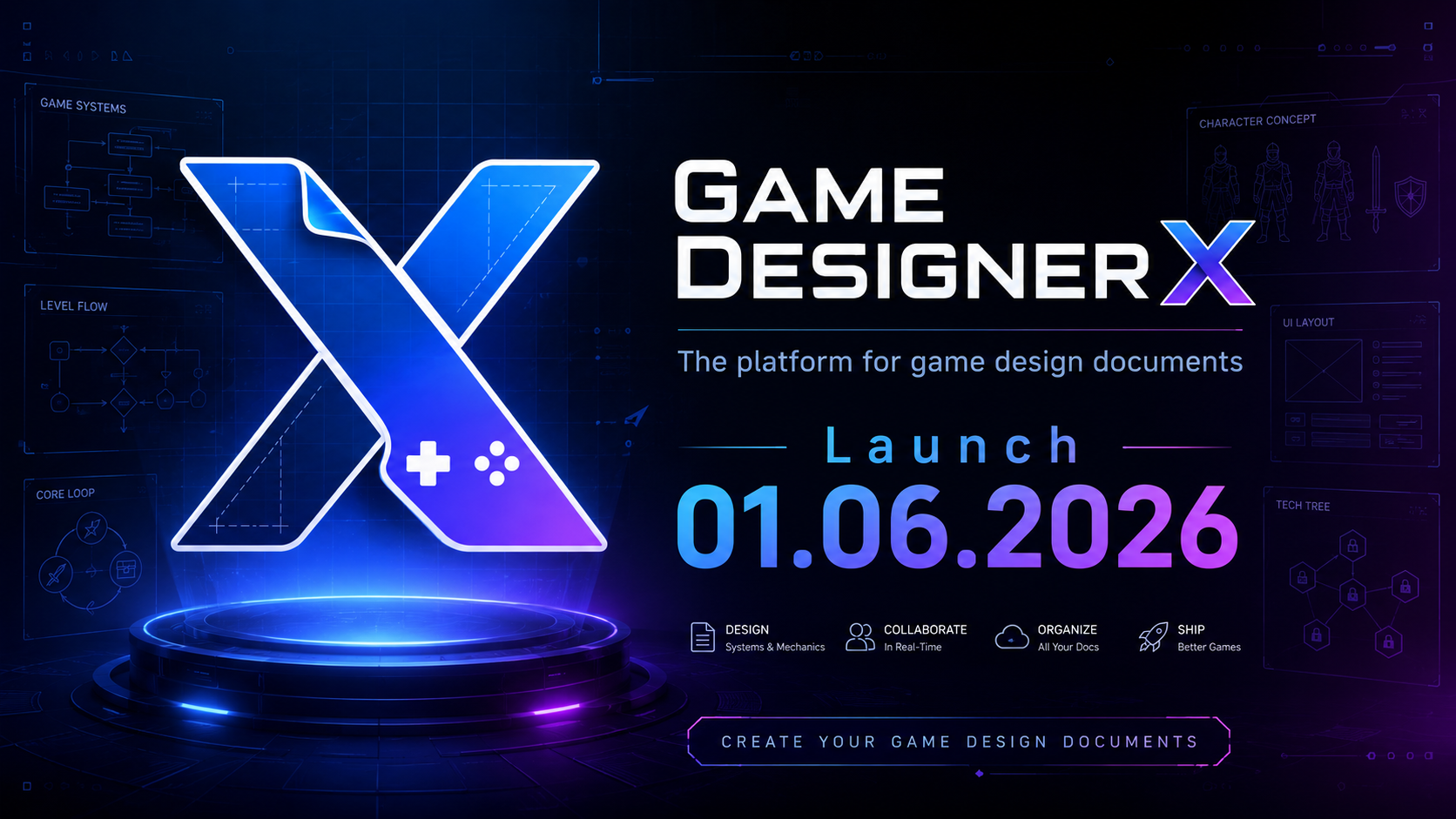
Game Designer X is launching on 01.06.2026
launchgame designer x

Game Designer X is launching on 01.06.2026

Game Designer X is planned to launch on 01.06.2026.

Marc Frädrich2 min
GDX
hellogame designer

Introducing Game Designer X — A Modern Workspace for Game Design

Game Designer X is a modern platform for creating and organizing game design documents, characters, quests, worldbuilding, gameplay systems, and collaborative game development workflows. Built specifically for game developers and studios.

Marc Frädrich3 min